Sydney’s B2B market operates differently from most capital cities across Australia. Decision-makers here receive hundreds of cold messages each month, and single-touch outreach simply doesn’t cut through.
Forrester Research found that B2B buyers engage with an average of 27 content pieces before purchasing. In professional services hubs like Sydney, that number climbs higher because buyers rely on trusted networks.
This guide breaks down the multi-touch approach to lead generation Sydney businesses actually need. You’ll learn which channels to sequence and the ideal timing between touches.
Key Takeaways
- Sydney B2B buyers typically require 8 to 12 touchpoints across multiple channels before they agree to a sales conversation
- The sequence of channels matters more than the total number of touches, with LinkedIn followed by email followed by phone producing the strongest conversion rates
- Spacing touchpoints 3 to 5 business days apart respects buyer attention without losing momentum in a competitive market
- Multi-touch campaigns that combine at least three channels outperform single-channel outreach by 287% according to Aberdeen Group research
Why Do Sydney B2B Buyers Demand So Many Sales Touchpoints?
Sydney houses Australia’s densest concentration of professional services firms, technology companies, and financial institutions. Every one of these organisations faces aggressive outbound prospecting from local and international vendors daily.
That volume of competing messages means decision-makers have built strong filters against generic outreach. Breaking through requires more touches, better sequencing, and genuine value at every stage of the engagement.
Trust Takes Multiple Interactions
A single cold email or LinkedIn message rarely generates a response from a senior buyer here. RAIN Group’s Centre for Sales Research found that 82% of B2B buyers accept meetings only after multiple interactions.
“The days of booking a meeting off one cold call are largely behind us in mature B2B markets. Today’s buyers want to see consistency across multiple channels before they invest their time in a conversation,” says Mary Shea, Global Innovation Evangelist at Outreach.
Sydney’s professional culture values relationship depth over transactional speed. Buyers here check your LinkedIn profile, read your content, and verify your credibility through mutual connections before responding to any outreach attempt.
The Professional Services Factor
Professional services firms dominate Sydney’s CBD. Accounting, legal, consulting, and IT firms make up a significant share of the B2B buyer market. These buyers are analytical, risk-averse, and deliberate in every purchasing decision they make.
Read More About Innovative Lead Generation Tactics
How Many Touches Does a Typical Sydney B2B Sale Require?
The answer depends on your deal size, buyer seniority, and industry vertical. However, data consistently shows that B2B sales requiring considered decisions need significantly more touches than most companies currently deliver across their outreach.
The 8 to 12 Touch Benchmark
Aberdeen Group research found that multi-touch, multi-channel campaigns achieve 287% higher conversion rates than single-channel outreach. That’s a significant margin that most sales teams can’t afford to ignore.
For Sydney’s mid-market B2B segment, the sweet spot falls between 8 and 12 touches spread across a 30 to 45 day engagement window. Fewer touches rarely build the full momentum you need to book a meeting.
“Most sales teams give up after three or four attempts. The research tells us that the majority of B2B deals close between the eighth and twelfth touch. Persistence, when paired with value, is the differentiator,” says Jeb Blount, CEO of Sales Gravy and author of Fanatical Prospecting, cited in Sales Gravy.
Each touch should deliver genuine value rather than simply repeating a meeting request. Share relevant insights, reference industry challenges, and show that you understand their specific business context.
Touch Distribution Across the Funnel
Not every touch carries equal weight. Early touches build awareness and credibility, while later touches create urgency and drive the actual booking. Here’s how effective campaigns typically distribute touchpoints across their full engagement window.
- Touches 1 to 3 focus on awareness, introducing your firm and sharing a relevant insight tied to the prospect’s industry or role
- Touches 4 to 6 shift toward credibility, referencing case studies, client results, or third-party validation that proves your expertise
- Touches 7 to 9 drive consideration, presenting a specific offer and connecting the prospect’s pain points to your solution directly
- Touches 10 to 12 create urgency, using social proof, scarcity, or a compelling reason to meet now rather than delaying
| Your Prospects Need More Than One Message to Convert Most Sydney B2B campaigns fail because they stop after three touches. A structured multi-channel sequence dramatically increases your meeting rate with qualified decision-makers. |
How to Build a Multi-Channel Touchpoint Sequence That Works
The channel you use for each touch matters as much as the message itself. Sydney B2B buyers respond best when you layer different communication methods in a deliberate order that builds familiarity before asking for commitment.
The Optimal Channel Sequence
Start with LinkedIn because it’s where Sydney’s professionals live. A well-crafted connection request followed by a value-driven message establishes your presence without the intrusiveness of a cold call or unsolicited email arriving first.
After LinkedIn establishes initial contact, move to email for your next set of touches. Email lets you share longer-form content, case studies, and personalised insights that don’t fit LinkedIn’s format.
Phone calls work best as the third channel in the sequence. By the time you ring a prospect who’s already seen your LinkedIn profile and read your emails, you’re no longer a stranger. That recognition reduces call resistance dramatically.
Sequencing for Professional Services Buyers
Sydney’s professional services buyers respond particularly well to this three-channel framework. A structured appointment setting approach using this sequence consistently books more meetings.
This outperforms any single-channel campaign running in isolation. The layered approach builds trust before asking for commitment, which suits how Sydney’s professional buyers prefer to engage with vendors.
“The most effective B2B outreach sequences we see in Australia combine LinkedIn engagement, personalised email, and strategic phone calls in that exact order. Each channel primes the prospect for the next,” says Matt Heinz, President of Heinz Marketing.
Professional services buyers in Sydney also respond well to content-based touches between outreach messages. Sharing a relevant article via LinkedIn before sending a pitch email creates an impression of generosity.
Read More About Effective Lead Generation Strategies for Australian SMEs
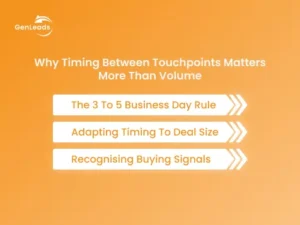
Why Timing Between Touchpoints Matters More Than Volume
Getting the spacing right between touches is critical. Too frequent and you annoy prospects. Too infrequent and they forget you exist entirely. Both extremes kill your conversion rate in Sydney’s competitive B2B landscape.
The 3 to 5 Business Day Rule
Research from Gartner’s B2B buying behaviour studies shows that prospects who receive touches spaced 3 to 5 business days apart convert at significantly higher rates than those who receive daily or weekly outreach attempts from the same sender.
This spacing keeps you visible without triggering the “another pushy salesperson” reaction. Sydney buyers in senior roles appreciate firms that respect their time while maintaining a consistent presence.
Adapting Timing to Deal Size
For enterprise deals with six-figure annual contract values, extend the spacing to 5 to 7 business days and plan for a 60 to 90 day engagement window. These buyers involve more stakeholders and require internal consensus before agreeing to meetings.
Mid-market deals in the $20,000 to $100,000 range work best with the standard 3 to 5 day spacing over a 30 to 45 day window. This matches the faster decision-making rhythm of growing Sydney businesses.
Recognising Buying Signals
Your outsourced business development team should monitor prospect behaviour between touches. Profile views, email opens, and website visits all indicate rising interest.
These behavioural signals should trigger a faster follow-up. Content downloads and LinkedIn activity are the strongest indicators that a prospect is moving closer to a buying decision in this competitive market.
When a prospect visits your website after receiving an email, the next touch should happen within 24 hours. That behavioural signal represents a warm moment where responsiveness dramatically increases your chance of booking the meeting.
Stop Guessing When to Follow Up Data-driven timing between touches separates effective campaigns from spam. Let our team build a sequenced outreach plan that matches Sydney buyer behaviour patterns. |
Which Channel Combinations Perform Best for Sydney B2B?
Not every channel combination delivers equal results. The data shows clear winners for Sydney’s B2B market, and the best-performing combinations consistently involve at least three distinct channels working together as a coordinated system.
LinkedIn Plus Email Plus Phone
This combination remains the gold standard for lead generation Sydney campaigns targeting mid-market and enterprise buyers. LinkedIn builds awareness, email delivers depth, and phone books it.
Companies running this three-channel combination in the Sydney market report meeting booking rates between 8% and 15% of contacted prospects. Single-channel campaigns targeting the same audience typically deliver 1% to 3% conversion rates at best.
Adding Content Syndication as a Fourth Touch
For longer sales cycles, adding content syndication enhances the core three-channel framework. When prospects encounter your thought leadership on industry publications before receiving outreach, they already trust your brand.
A strong lead generation consulting partner helps you identify which publications your target buyers read and build a distribution plan that supports your outbound work.
Channels to Avoid in Sydney B2B
Generic display advertising and mass email blasts consistently underperform in Sydney’s B2B market. These channels lack the personalisation that sophisticated buyers expect and often damage brand perception more than they generate qualified pipeline.
Social media advertising on Facebook and Instagram rarely delivers quality B2B leads in the Australian professional services market. Budget spent here generates impressions but rarely produces qualified meetings.
Read More About Cost of B2B Lead Generation Services
Measuring Multi-Touch Campaign Performance the Right Way
Multi-touch campaigns create a measurement challenge because no single touchpoint deserves full credit for a booked meeting. Proper attribution helps you optimise each channel’s contribution accurately.
First-Touch Versus Multi-Touch Attribution
First-touch attribution gives all credit to the channel that initiated contact. Last-touch credits the channel that booked the meeting. Both models are misleading when you use them on their own for multi-touch campaigns.
Multi-channel lead generation Sydney campaigns need better models because single-touch attribution ignores the contributions of every interaction in between the first and last touch.
Multi-touch attribution distributes credit across every interaction proportionally. This model reveals that LinkedIn initiates relationships, email nurtures them, and phone converts them into booked meetings.
Key Metrics for Multi-Touch Campaigns
Your outsourced business development team should track these metrics across the entire sequence. The combined picture reveals true campaign performance.
- Touch-to-meeting ratio measures how many total touches your team delivers before booking each qualified meeting across all channels
- Channel contribution rate shows which channels appear most frequently in sequences that convert to meetings
- Sequence completion rate tracks what percentage of prospects receive the full planned touch sequence before dropping off
- Time-to-meeting measures the average number of days from first touch to booked meeting across your Sydney campaign
Optimising Based on Data
Review your multi-touch data monthly and adjust both messaging and channel mix based on what the numbers show. A strong appointment setting programme refines its approach using real performance data.
If your LinkedIn response rates drop below 5%, refresh your messaging and connection request copy. If email open rates fall under 25%, test new subject lines and experiment with different sending times.
Partnering with a lead generation consulting team ensures your optimisation decisions are grounded in benchmarks from real Sydney campaigns rather than guesswork.
Ready to Fill Your Pipeline with Qualified Meetings? Our team builds structured multi-channel outreach programmes tailored to your Sydney buyer profile and deal size. |
Conclusion
Sydney’s B2B market rewards companies that commit to multi-touch engagement across carefully sequenced channels. Single-touch outreach isn’t enough when decision-makers expect consistency and value first.
The firms that win plan 8 to 12 touches across LinkedIn, email, and phone. They space them 3 to 5 business days apart and adapt their timing based on the real buyer signals coming from each individual prospect.
Leadgen Agency works with Sydney businesses to build exactly this kind of structured, data-driven outreach programme that books qualified meetings with the right decision-makers on a predictable, consistent basis.
Whether you’re building an internal team or using outsourced business development, the key is committing to the sequence. Get in touch to discuss your pipeline goals.
Key Statistics Referenced
| Statistic | Source |
| B2B buyers engage with 27 content pieces before purchasing | Forrester Research |
| 82% of buyers accept meetings after multiple interactions | RAIN Group Centre for Sales Research |
| Multi-touch campaigns achieve 287% higher conversion rates | Aberdeen Group |
| Three-channel campaigns deliver 8% to 15% meeting booking rates | Sydney campaign benchmarks |
FAQs
How many touchpoints do Sydney B2B buyers need before booking a meeting?
Most Sydney B2B buyers require between 8 and 12 touchpoints across multiple channels before agreeing to a sales meeting. This range accounts for the sophisticated professional services market where decision-makers receive heavy outreach volume daily. Companies that stop after three or four attempts miss the majority of potential conversions that happen later in the sequence.
What is the best channel sequence for multi-touch B2B outreach?
The most effective channel sequence for Sydney B2B outreach starts with LinkedIn to build awareness, moves to personalised email for depth and credibility, and finishes with phone calls to create the personal connection that books meetings. This three-channel combination consistently outperforms single-channel campaigns by delivering 8% to 15% meeting booking rates compared to 1% to 3% for single-channel approaches.
How far apart should touchpoints be in a B2B campaign?
Spacing touchpoints 3 to 5 business days apart produces the strongest conversion rates for mid-market Sydney B2B campaigns. This timing keeps your firm visible without triggering negative reactions from busy decision-makers. For enterprise deals with larger contract values, extending the spacing to 5 to 7 business days over a longer 60 to 90 day engagement window typically works better.
Why does single-channel outreach fail in Sydney B2B markets?
Single-channel outreach fails because Sydney’s B2B decision-makers have developed strong filters against repetitive contact from one source. A prospect who ignores five LinkedIn messages may respond to an email that references their recent company announcement. Multi-channel engagement creates multiple recognition points that build familiarity and trust far more effectively than any single channel can achieve alone.
How do you measure which touchpoint actually converted a B2B lead?
Multi-touch attribution models distribute credit across every interaction in the engagement sequence rather than assigning all credit to the first or last touch. This approach reveals that LinkedIn typically initiates relationships, email nurtures interest, and phone calls convert leads into meetings. Tracking touch-to-meeting ratios, channel contribution rates, and time-to-meeting metrics gives you the data needed to optimise each channel.