Most Sydney B2B companies understand outbound prospecting and external BD services as separate concepts. Plenty of articles explain what each function does individually and why it matters for revenue growth.
What nobody covers is the operational detail of running both together. How do you actually ramp them in parallel, measure combined performance, and decide when you need one function versus both simultaneously?
This guide delivers the week-by-week playbook that Sydney B2B teams have been asking for. You will learn precisely how outbounding creates the awareness that outsourced BD converts into qualified meetings.
The companies getting the best pipeline results in Sydney right now are not choosing between these two functions. They combine them with clear operational handoffs, shared KPIs, and defined escalation paths.
Key Takeaways
- Outbound prospecting creates the awareness that outsourced BD converts into booked meetings, and running both together shortens the ramp from 12 weeks to roughly 6
- A structured week-by-week ramp with defined handoff points prevents the most common failure mode, which is launching both without coordination
- Combined KPIs like awareness-to-meeting ratio and cost per qualified meeting give clearer pipeline visibility than tracking each function separately
- Sydney companies with deal sizes above $20,000 AUD see the strongest ROI from running outbounding and outsourced BD simultaneously
Why Do Outbounding and Outsourced BD Work Better Together?
The core problem with running outbounding marketing alone is awareness without a structured conversion mechanism. Nobody follows up on engaged prospects systematically.
Running outsourced business development alone creates the opposite problem. Your BD team contacts prospects who have never heard of your brand, lowering response rates.
When these two functions operate together, outbounding builds familiarity before the BD team makes contact. The prospect has already seen your company name multiple times before receiving a direct call.
“Companies that combine brand awareness campaigns with direct outreach see 40% higher response rates compared to cold outreach alone.” ,Tara Robertson, Chief Marketing Officer, Bitly (Source: Demand Gen Report)
The Awareness-to-Conversion Handoff
This handoff is where most Sydney B2B companies fail. They launch outbound campaigns and BD simultaneously without defining when a prospect moves from one function to the other, resulting in duplicated effort.
A proper handoff happens when a prospect demonstrates engagement. That means they have opened three or more emails, clicked a link, or visited your website. The BD team then steps in with a personalised approach.
Warm prospects convert at rates two to three times higher than cold contacts. The operational discipline to track engagement signals before BD outreach separates high-performing combined programmes from scattered efforts.
| Ready to Build a Combined Outbound Pipeline? Discover how Sydney B2B companies ramp outbounding and outsourced BD together for faster qualified meetings. |
How Does the Week-by-Week Ramp Actually Look in Sydney?
Most agencies describe the ramp process in vague terms. Here is the actual operational timeline that works for Sydney B2B companies launching a combined outbounding and outsourced BD programme in practice.
Weeks One and Two: Foundation Build
The first two weeks focus entirely on preparation. Your outbound campaigns need targeting lists, messaging sequences, and content assets ready before a single email goes out. The BD team builds qualifying criteria.
During this phase, you should finalise your ideal customer profile with firmographic and technographic data. Sydney markets require specific industry targeting because the B2B landscape differs from Melbourne or Brisbane.
Weeks Three and Four: Outbounding Launch
Outbounding campaigns go live in week three with multi-channel sequences across email, LinkedIn, and targeted content distribution. The goal is not to book meetings yet but to build brand familiarity across your account list.
Your BD team remains in preparation mode during these two weeks, monitoring engagement data as it flows in. They review which accounts show the strongest engagement signals and prepare personalised outreach scripts.
Weeks Five and Six: BD Activation
By week five, your outbounding efforts have generated enough engagement data to identify warm accounts. The BD team begins direct outreach to prospects showing interest through email opens, link clicks, or downloads.
“The biggest mistake in external BD partnerships is contacting prospects too early, before they have any brand awareness. Waiting until you see engagement signals improves meeting acceptance rates by 35 to 50 percent.” ,Matt Heinz, President, Heinz Marketing (Source: Heinz Marketing Blog)
This staggered launch means your first qualified meetings typically land in weeks five through seven, rather than weeks eight through twelve with cold outreach alone. The time savings are substantial for pipeline velocity.
Read More About How Appointment Setting Services Can Skyrocket Your Sales in 2026
Weeks Seven and Eight: Optimisation Cycle
The first full optimisation cycle happens here. You now have enough data to identify which outbounding channels drive the strongest BD conversion rates. Some Sydney markets respond better to LinkedIn sequences.
Your BD team provides feedback on meeting quality, common objections, and prospect questions. This intelligence feeds directly back into outbounding content and messaging, creating a continuous improvement loop.
Which Operational KPIs Measure the Combined BD Approach?
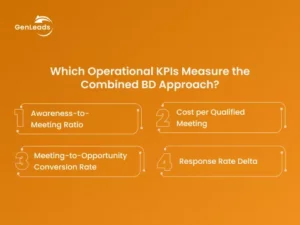
Tracking outbounding and BD separately gives you incomplete pipeline visibility. The real insight comes from combined KPIs that measure how well both functions feed each other across the full sales pipeline.
Awareness-to-Meeting Ratio
This measures how many prospects who engage with outbounding content eventually convert to a booked BD meeting. A healthy benchmark for Sydney B2B markets sits between 8 and 12 percent for well-targeted campaigns.
Track this weekly from the moment BD activation begins. Rising ratios indicate that your outbounding messages resonate with the right audience and that BD follow-up timing aligns with prospect readiness signals.
Cost per Qualified Meeting
Calculate this by combining your total outbounding spend and BD costs, then dividing by meetings that meet your qualification criteria. Sydney companies typically achieve $180 to $350 per qualified meeting with combined programmes.
According to the RAIN Group, organisations that coordinate prospecting and development efforts reduce their average cost per opportunity by 28 percent compared to those running siloed programmes across separate teams.
Meeting-to-Opportunity Conversion Rate
This KPI tells you whether BD meetings actually progress into genuine sales opportunities. Target 30 to 45 percent conversion from meeting to opportunity. Rates below 25 percent suggest unqualified prospect targeting.
“Pipeline velocity depends on alignment between demand generation and business development. When both teams share KPIs, the average sales cycle compresses by 24 percent.” ,Mary Shea, Global Innovation Evangelist, Outreach (Source: Outreach.io Resources)
Response Rate Delta
Compare the response rate of prospects who received outbounding content before BD contact against those who received cold outreach only. This delta quantifies the exact value outbounding adds to BD performance.
Expect a 25 to 40 percent improvement in response rates for warmed prospects. This metric alone justifies the investment in running both functions together for most Sydney B2B companies with longer sales cycles.
Read More About Outsourcing in Australia: Your Ultimate Guide to Business Growth or Potential Pitfall?
When Should Sydney B2B Companies Use One Function or Both?
Not every B2B company in Sydney needs both outbounding marketing and outsourced business development running simultaneously. The decision depends on deal size, sales cycle length, and current pipeline health.
Deal Size Threshold
If your average deal value sits below $10,000 AUD, outbound prospecting alone may generate sufficient volume. The economics of adding BD only stack up when each closed deal justifies the additional acquisition cost.
For deals above $20,000 AUD, the combined approach almost always delivers superior ROI. Larger deals require more touchpoints, deeper personalisation, and direct human conversation before a prospect commits to a meeting.
Sales Cycle Consideration
Short sales cycles of two to four weeks can often be served by outbounding alone. A strong sequence moves prospects from awareness to purchase without direct BD intervention in these shorter timeframes.
Complex sales cycles exceeding eight weeks nearly always benefit from adding BD resources. Sydney professional services firms and SaaS companies typically fall into this longer cycle category for their deals.
These businesses benefit from lead generation strategies that combine awareness building with direct prospect engagement over extended timelines before any purchase commitment.
Pipeline Health Assessment
If your current pipeline covers less than three times your quarterly revenue target, you need both functions working simultaneously. A healthy pipeline sits at three to four times target coverage overall.
Companies with pipelines above four times target may run outbounding as a maintenance function while pausing BD. This reserves budget and keeps the brand visible without the higher cost of active BD outreach across your accounts.
Building Your Outbound Awareness to Meeting Pipeline Now
The handoff between outbounding awareness and BD meeting booking requires specific operational infrastructure. Without it, warm prospects fall through the cracks and your combined investment consistently underperforms.
Engagement Scoring Framework
Build a simple scoring model that tracks prospect interactions across all outbounding channels. Assign points for email opens, link clicks, website visits, and content downloads. Set a threshold that triggers BD outreach.
Most Sydney B2B companies find that a threshold of 15 to 20 engagement points works well. This typically means a prospect has interacted with your brand four to six times before receiving a BD call or email.
Shared Technology Stack
Both functions need access to the same CRM and appointment setting workflow tools. The outbounding team logs engagement data that the BD team reads in real time for prospect prioritisation.
Without shared visibility, the BD team operates blind and outbounding cannot see which efforts produce meetings. Invest in a unified platform before launching to avoid data gaps that damage both functions.
Content Handoff Sequences
Your outbound content sequences should naturally progress toward BD engagement. Early sequences build awareness with industry insights while middle sequences introduce your company’s specific approach and proof points.
When the BD team contacts a prospect, they reference specific content the prospect engaged with. This personalised approach demonstrates attention to the prospect’s interests and builds trust faster than generic cold outreach.
Want to Launch a Combined Outbound Programme? Learn how Leadgen helps Sydney B2B companies build structured outbound pipelines that convert awareness into qualified meetings. |
How Do You Avoid the Most Common Ramp Failures in Practice?
The most frequent failure is launching outbound prospecting and outsourced BD simultaneously without the staggered ramp described above. BD contacts cold prospects while outbounding has not yet built any awareness at all.
Misaligned Messaging
Your outbounding content must align with what the BD team says on calls. If outbounding positions your company as a strategic partner but BD pitches transactional services, prospects experience cognitive dissonance.
Review all outbounding sequences alongside BD call scripts before launch. Ensure the value proposition, tone, and key proof points remain consistent. This alignment exercise takes half a day and prevents confusion.
Premature BD Activation
Activating BD before sufficient engagement data exists wastes your BD team’s time on cold contacts. The engagement scoring threshold should be non-negotiable, even if leadership pressures the team to start immediately.
Set clear expectations with stakeholders: weeks one through four build awareness, weeks five onward produce meetings. Any deviation from this timeline typically results in lower quality meetings and longer ramp times.
Insufficient Feedback Loops
The BD team must report back to the outbounding function weekly. Which messages resonated during calls? What objections came up? Which competitor comparisons did prospects raise? This intelligence refines content.
Without this feedback loop, outbounding continues sending messages that may not align with what prospects care about. Schedule a 30-minute weekly sync between both teams to review feedback and adjust messaging.
Read More About How to Outsource Your BDM to Benefit Your Business
Aligning Your Sales Training With Outsourced BD Operations
Your internal sales team needs to understand how outsourced BD fits into the broader pipeline. Without sales training alignment, handoffs between BD and closers suffer.
Meeting Handoff Protocol
Define exactly what information transfers from the BD team to your sales representatives when a meeting is booked. This should include engagement history, content consumed, pain points, and the prospect’s timeline.
Standardise this in a one-page meeting brief that the BD team completes for every qualified meeting. Your sales representatives should review this before every call to avoid repeating questions already answered.
Qualification Alignment
The BD team and your sales team must agree on what constitutes a qualified meeting. Use a shared framework like BANT or MEDDIC, adapted to your market. Without agreed criteria, BD books meetings your sales team rejects.
Investing in sales training that covers qualification alignment ensures both teams share the same standards. Run monthly calibration sessions to prevent criteria drift.
Closed-Loop Reporting
Track every meeting from BD booking through to closed-won or closed-lost. This closed-loop data reveals which outbound channels and BD approaches produce not just meetings, but actual revenue for your business.
Share revenue attribution data with both the outbounding and BD teams monthly. When people see how their specific efforts contribute to closed deals, engagement and overall performance improve measurably.
Need Expert Guidance on Your BD Strategy? Get a tailored external BD development plan built for your Sydney B2B pipeline goals and sales cycle. |
Conclusion
Running outbounding marketing and outsourced business development together is not complicated, but it requires operational discipline. The week-by-week ramp and shared KPIs give Sydney B2B companies a clear framework.
The companies producing the strongest pipeline results treat these two functions as a unified system rather than separate departments. The awareness that outbounding creates directly fuels BD conversion rates.
Leadgen works with Sydney B2B companies to build exactly this kind of combined pipeline operation, from outbound awareness campaigns through to qualified meetings booked on your calendar every single week.
If your current pipeline sits below three times your quarterly target, the time to launch a combined programme is now. Get in touch with our team to discuss how this fits your goals.
FAQs
How long before a combined outbound and BD programme books meetings?
With a properly staggered ramp, most Sydney B2B companies see their first qualified meetings in weeks five through seven. Outbounding campaigns launch in week three to build awareness, and BD activation follows in week five once engagement data identifies warm prospects. Consistent meeting flow typically establishes by week eight, compared to weeks ten through twelve with cold outreach alone.
What budget should Sydney companies allocate for combined outbound and BD?
Sydney B2B companies should expect to invest $6,000 to $15,000 AUD per month for a combined programme covering outbound prospecting and outsourced BD. This includes outbound channel costs, BD team resources, technology stack, and content creation. The combined cost is typically 30 to 40 percent less than hiring equivalent in-house resources for both functions.
How do you measure whether outbounding actually helps outsourced BD performance?
Track the response rate delta between prospects who received outbounding content before BD contact versus those contacted cold. Most programmes show a 25 to 40 percent improvement in response rates for warmed prospects. Also measure the awareness-to-meeting ratio, which should sit between 8 and 12 percent for well-targeted Sydney B2B campaigns.
Can small B2B companies in Sydney afford both functions simultaneously?
Companies with deal sizes above $20,000 AUD and quarterly revenue targets exceeding $150,000 typically see positive ROI from running both functions. Below those thresholds, starting with outbound prospecting alone and adding BD once you have proven engagement data is the more prudent approach. The decision framework depends on deal size, sales cycle length, and current pipeline coverage.
What happens if we launch both functions at the same time without staggering?
Launching simultaneously is the most common failure mode. The BD team contacts prospects who have zero brand awareness, resulting in response rates 35 to 50 percent lower than a staggered approach. This wastes BD resources, frustrates the team, and often leads companies to conclude that outbound does not work for them, when the real issue was operational sequencing rather than strategy.